Hi ,  welcome  |  Textile views  |  Political views  |   CA and CS News  |   Legal News  |   Government jobs  |  Textile jobs 


how to make a vegetable dyeing - part I

Written By Views maker on October 17, 2008 | 10/17/2008

# Chop banana skins into small pieces.
# Cover them with water and let the mixture sit for a few days in a warm location, stirring the mixture each day.
# The mixture will get a bit smelly, so it is best to store it outside,... covered. You can add some baking soda and sugar to the mixture.
# Strain the mixture through a cheesecloth or nylons stocking to remove the pulp.
# Add the liquid to a dyepot filled with water. Simmer for x-about an hour.
# Add clean, premordanted wool to the dyepot.
# Simmer for an hour or until sufficient colour is obtained.
# Allow the dyepot to cool. Then remove the dyed wool.
# Rinse and let dry.
10/17/2008 | 0 comments
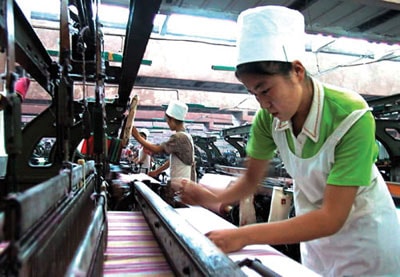
Non-wovens in India

Ginni Filaments Ltd is a textile manufacturer which produces a non-woven based fabric. This revolutionary fabric is made in a Gujarat plant and is exported primarily to the United States and Europe. The material has been used in a number of clothing applications including uniforms, and the newest application is for medical supplies like surgical masks. Historically, the company has been making fabric for companies such as JC Penney Co. and the Benetton Group SpA. Eventually the company hopes a .. large amount of their production will be sold within India rather than being exported.

What many people don’t know is that textiles are being used for a number of purposes that extend far beyond clothing. For example, textiles are used to make material to reinforce banks along rivers or to make tea bags. Other industries taking an interest in this fabric are agriculture and plant manufacturing operations. The textile can be used to reinforce wheels or conveyor belts and is used for a number of agricultural reasons.

The India company SRF and Neo Corp. have been expanding their textile operations by purchasing foreign companies. Neo Corp. bouth Euro Plast Ltd which is based in the UK. SRF bought Thai Baroda Industries Ltd and South African Industrial Technical Textiles (Pty) Ltd.

The growth of non-woven fabric uses has been phenomenal. There are now many companies pursuing non-woven textile applications, because apparently there are unlimited uses. For example, Ahlstrom Corp., a Finnish company, is building a new plant which will produce non-woven fabric. The material is going to be used primarily in medical clothing and supplies.

Over time it is expected. there will be many more uses for non-woven fabric.
10/17/2008 | 0 comments

Tirupur Exporter cautious over Retail recession in USA

What is common between Eddie Bauer, Gap, Talbots and Ann Taylor? They are marquee retailers of the US, which are shutting stores and thereby sending shivers down the spine of Tirupur exporters.

Take a look at the sample list of store closures in the US: Eddie Bauer has closed 27 shops in the first quarter and plans to close a few more by the end of 2008. Fashion Bug, Catherines Plus Sizes will close about 150 under-performing stores this year. The Talbots group has announced that it will close Talbots Kids and Talbots Mens Concepts by September 2008. In all, Talbots will close 78 mens and children's stores. Walt Disney said it has also obtained the right to close about 98 Disney Stores in the US. Gap Inc, whose brands include Old Navy and Banana Republic, has announced plans to close 85 stores as it continues to struggle to attract customers. Ann Taylor will close 117 stores between 2008 and 2010. What all this implies are lower orders, lower business followed by retrenchment. And with the financial turmoil spreading to Europe, orders from that continent are slowing down too.

“Tirupur has over three lakh people dependent on garment exports. With fresh orders difficult to come by, businesses will find it difficult to stay afloat. The Tirupur Exporters’ Association expects a 5% drop in exports this year. It would be safe to assume there would be job losses of anything between 10,000 and 15,000 in the coming months, though none of the big manufacturers has resorted to this,” an exporter said.
However, Celebrity Fashions, which works for US retailer Eddie Baur, said there is no slowdown in orders. “It is business as usual, but we have to be cautious.” Edelweiss Research has said that US imports of apparel from India this year (till August) has fallen by 4.8%. Yarn imports have also dropped by 7% for the same period. Till August ’08, India’s textile exports to the US declined 1.6% year-on-year to $3.5 billion and market share increased marginally to 5.7%. “The slowdown in the US will affect the purchasing power of consumers, affecting discretionary spending that includes spending on clothes.” Domestic suppliers may see lower orders and also lower margins due to lower prices being offered by US firms.
According to estimates, textile and garment exports are likely to touch $24.6 billion in ’08-09, which is short by a wide margin against the government targeted figures of $31.17 billion in this fiscal.
10/17/2008 | 0 comments

Tirupur Yarn Rate - October 2008

Written By Views maker on October 15, 2008 | 10/15/2008

counts

Grey m�lange

(85c/15p)

Ecru melange

  (97c/3p)

Light Grey Melange (93c/7p)


Grey Melange

Slub(85c /    15p)

20's

      126

      124

             122

        175

25's

      129

      127

             129

         180

30's

      133

      131

              133

         185

34's

      139

      137

              139

          182

40's

       149

      147

              149

          193


Cotton / Polyester blend yarns


counts

Blend

S.combed

combed

10's

65/35

109

-

10's

52/48

109


20's

40/60

110

119

20's

50/50

110

119

20's

65/35

110

119

24's

40/60

116

125

24's

50/50

116

125

24's

65/35

116

125

30's

40/60

122

131

30's

50/50

122

131

30's

65/35

122

131

Prices are in Indian Rupees

10/15/2008 | 0 comments

Monitoring Chinese Textile Imports to US

Written By Views maker on October 08, 2008 | 10/08/2008

The U.S. textile industry has put pressure on the U.S. Government to expand the Textile Monitoring Program (TMP), currently in place on apparel imports from Vietnam, to cover imports from China as well. The program should take start to cover U.S. textile and apparel imports from China beginning on January 1, 2009, the first day following the expiration of U.S.-China textile bilateral signed in 2005. The TMP currently monitors U.S. apparel imports from Vietnam for illegal dumping. Extending the TMP program to China once safeguards expire will provide the U.S. government with the necessary resources to effectively track China's import and pricing practices. This will enable it to react quickly if China illegally dumps its imports into the U.S. market and harms our domestic workforce, as well as the vulnerable in developing countries

10/08/2008 | 0 comments

E-mail Updates

Enter email Address

திருப்பூர் வகைப்படுத்தப்பட்ட விளம்பரங்கள்
--------------------------------
பூமி, வீட்டுமணை, தோட்டம் மற்றும் பல பிற வாங்க விற்க விளம்பரங்கள். கூடுதல் தகவலுக்கு

Blog Archives